Stepping into C-lab Art Space III, one is immediately struck by the atmosphere that the exhibition title, ‘Ghost in the Sea,’ evokes. The space is quiet, cold, and dimly lit, with a few spotlights scattered throughout, creating the impression of being in the depths of the ocean with only a few spots of light. Following the Maritime Silk Road and tracing the labour trade route that 19th-century Chinese coolies took from southern China to Mauritius, Africa, the artist Musquiqui Chihying leads the audience on a journey to explore the hidden networks of imperial control in the contemporary Afrasian Sea. ‘Ghost,’ the other key word in the exhibition title, represents the often-overlooked Chinese coolies who played a crucial role in globalization, as well as the surveillance data that flows through the submarine cable network deployed by China’s smart city initiatives in this region.
Located on the second floor, the video work ‘The Link’ implements theatrical lighting and sound effects, along with a three-channel arrangement of hexagonal screens to tell the economic and historical stories that the artist discovered in Mauritius. In a documentary style, it depicts the knowledge and historical research on coolies (Chinese indentured labor) and the smart city project, including interviews with local people, a visit to the Coolie Museum, historical sites, and an explanation of China’s Smart City. It also includes a dance that combines sci-fi style characters and Chinese opera dancers to convey the entangled narratives of past and present converging in Mauritius. ‘The Link’ is the most important work in the exhibition. It underpins the main theme that the entire exhibition seeks to say.
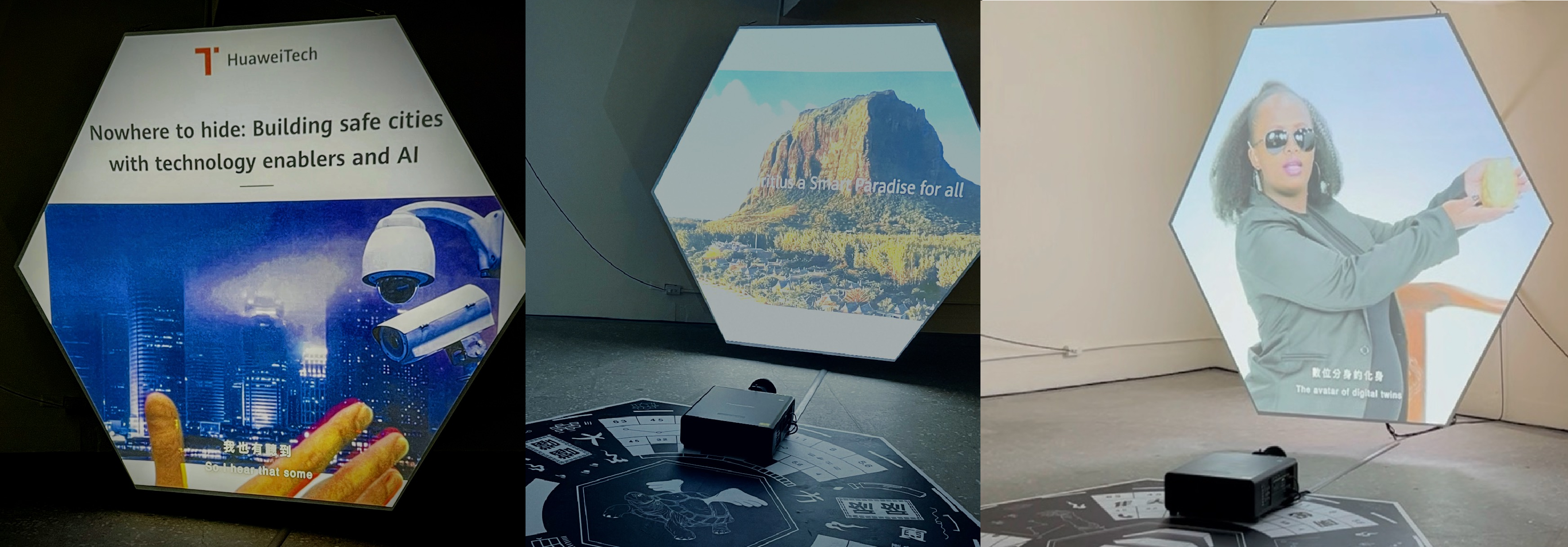
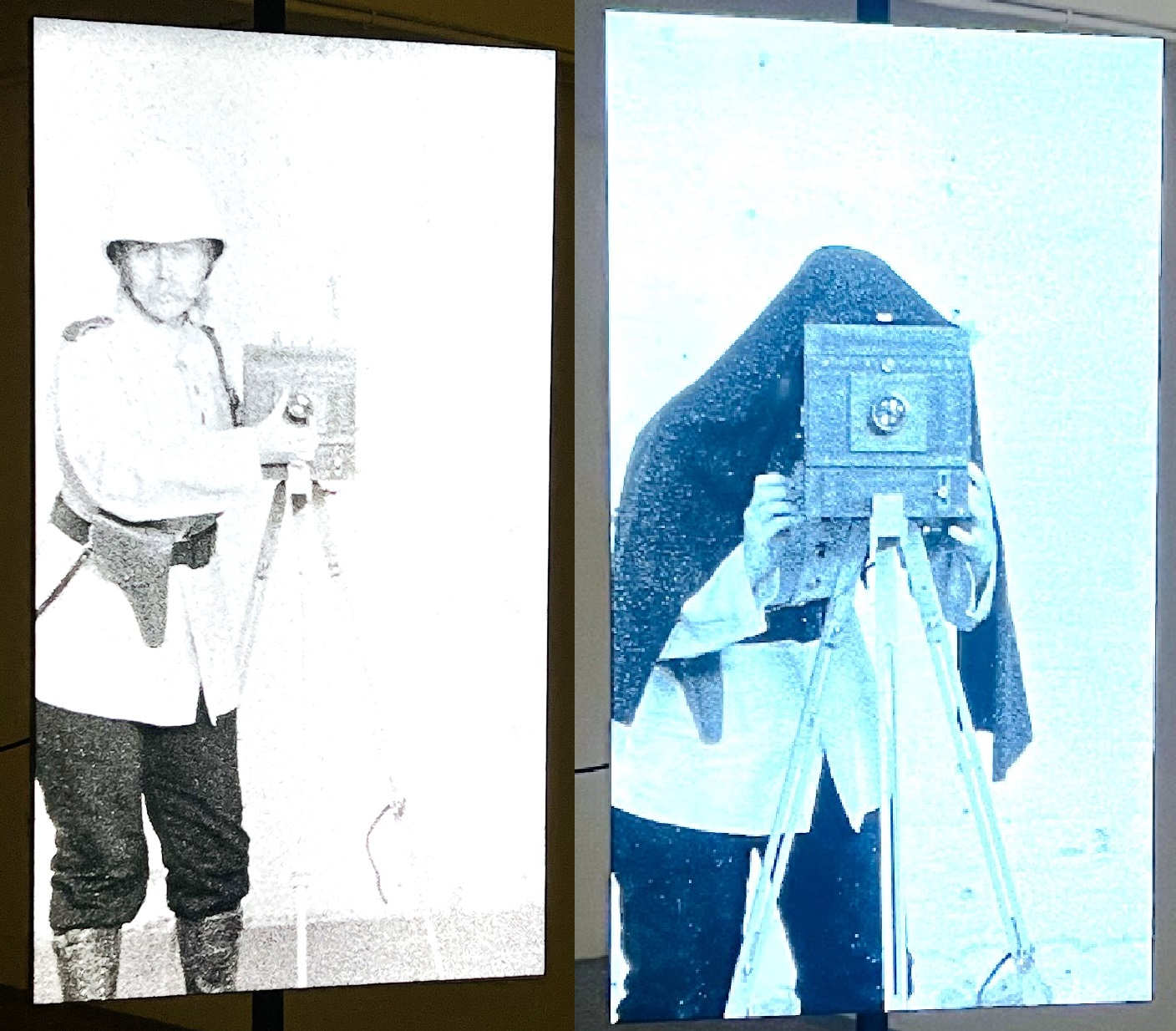
Back to the 19th-century, Mauritius was the first stop for Chinese coolies on their way to Western colonies, and also the forefront of Western colonial maps. Based on the knowledge at Coolie Museum and interviews with Chinese descendants, ‘The Link’ establishes an image of the Chinese coolies of that time. Mauritius was the first place in which Britain deployed photography for colonial control, taking large-scale photographs of Chinese coolies for archival purposes, replacing the previously unreliable written records of their physical appearance. Then, the film takes a turn to explore China’s contemporary smart city plan to build a ‘Safe City’ in Mauritius that is fully monitored by CCTV and data network. Here, ‘The Link’ cleverly links Britain’s imperial control to China’s contemporary use of the information technology, both deploying a form of colonial control in Mauritius with state-of-the-art technology.
‘The Link’ provides evidence to support the argument that both of the instances of imperial control are likely to be questionable. In the past, Britain used photography to record personal data on Chinese coolies, but it was only used to control them. In terms of labor contracts, it was never actually implemented on the individuals to whom these records corresponded. Ultimately, the fate of the coolies was no better than that of slaves before. Today, the artwork raises another question: is comprehensive surveillance under a smart city scheme really what a small tourist island like Mauritius needs, let alone Mauritius has one of the lowest crime rates in Africa. For smart city, ‘The Link’ points out that a collection of privacy data under comprehensive surveillance and digital control might be the real reason that the empire still attempts to haunt this island.
The video work ‘The Link’ presents a compelling argument that ghosts of the empire are still roaming the Afrasian Sea. In order to further understand the issues highlighted by this exhibition, I researched the current political and economic situation in Mauritius, as well as news articles about its smart city. Surprisingly, a different truth in Mauritius was revealed. First, the Mauritius government did have an active role in making the decision to introduce smart city surveillance systems to maintain public and tourism safety, supporting that the idea of Safe City in Mauritius is not entirely only advocated by China. Second, speaking of cyber security, Mauritius is one of the 15 countries out of the 55 member states of the African Union that has ratified the ‘African Union Convention on Cyber Security and Personal Data Protection’ (Mauritius ratified the convention in 2018).1 Furthermore, to support the capability of the Mauritius government to fulfil the Convention , according to the Index of Economic Freedom, Mauritius is commented as:
having a sound and transparent legal framework strongly upholds the rule of law, and the country’s efficient regulatory environment and open-market policies encourage broad-based and diversified economic development.2
While its government integrity rating is 52.3 points, it has a high judicial effectiveness score which is 81.2 points, and both scores are above the world average. These evaluations and descriptions of Mauritius paint a picture of a proactive, autonomous, and decision-making entity that is totally different from Chinese coolies in the 19th-century. In research-based exhibitions, more than often audience are positioned as docile learners. In ‘Ghost in the Sea,’ the audience cannot see this active role of Mauritius, and not everyone would delve further into such research. The discursive formation created by ‘Ghost in the Sea’ leads the audience to believe (or only see) the aspect of the imperial ghost continuing to haunt. By linking modern Mauritius to the image of a colonized and submissive Mauritius in the past, it prevents the audience from realizing the fact that Mauritius itself is rendered passive within the exhibition.
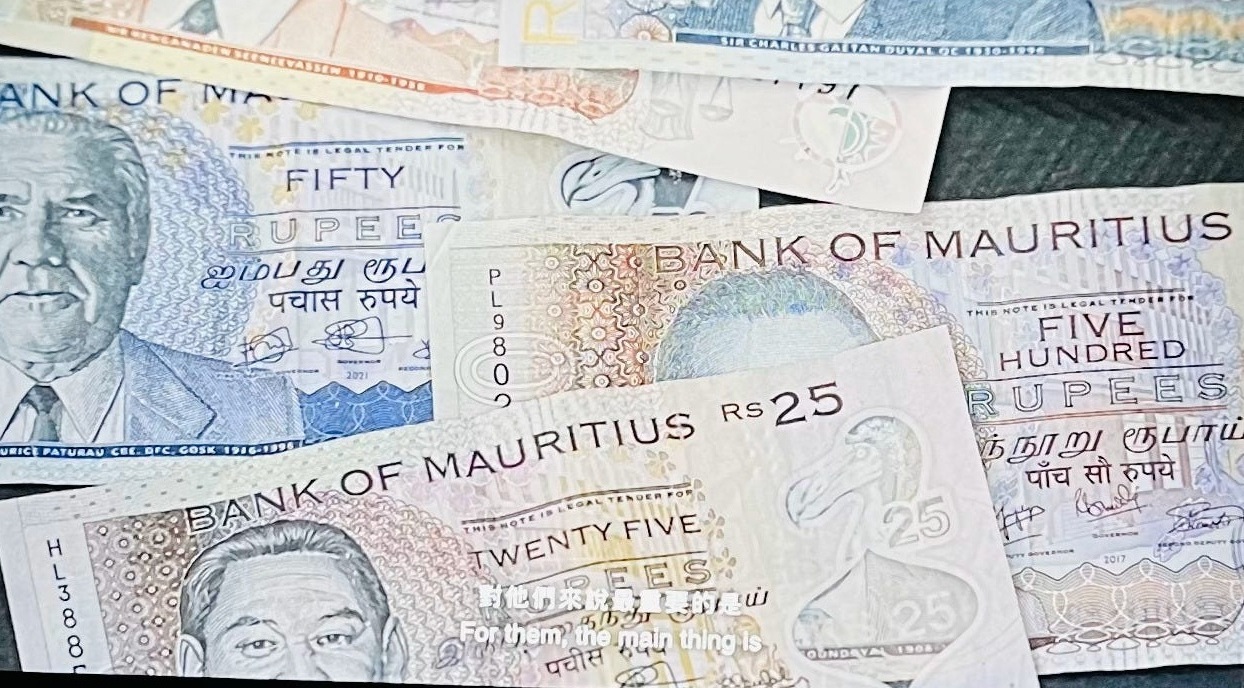
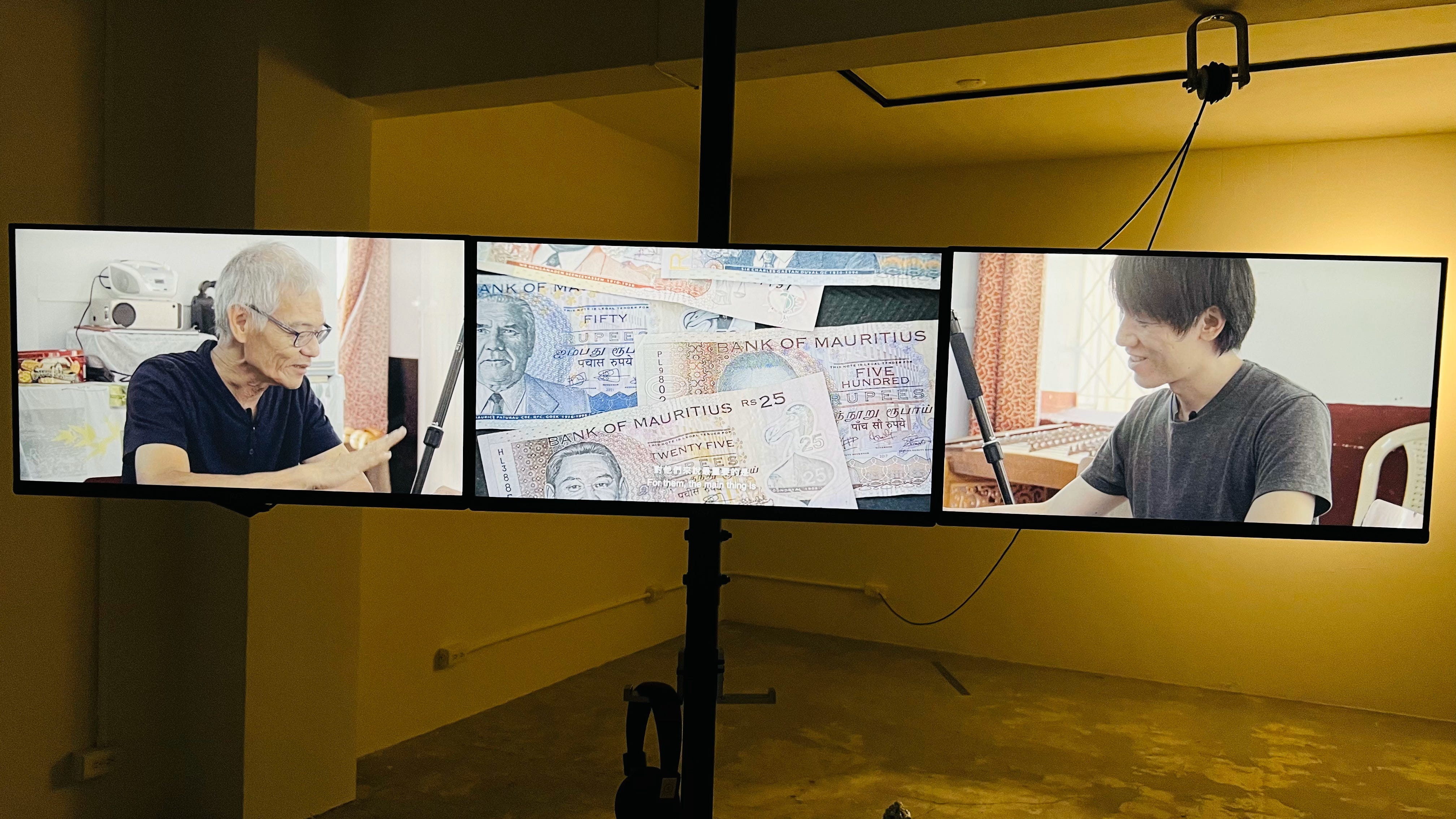
In the video artwork, ‘The Banknote,’ the artist has a conversation with the principal of a local Chinese school about the figures depicted on Mauritian banknotes. Each banknote features a prominent person from Mauritius. Unlike figures representing other ethnicities, Sir Moilin Jean Ah-Chuen, the only famous figure of Chinese descent, appears on the lowest denomination banknote, implying an invisible ethnic inequality. In the conversation, the artist asked: ‘Have you ever felt discriminated against as a Chinese person in your life?’ The principal firmly answers no. Although the response was contrary to the theme of ‘The Banknote,’ the artwork doesn’t delve deeper into this answer from the local resident.
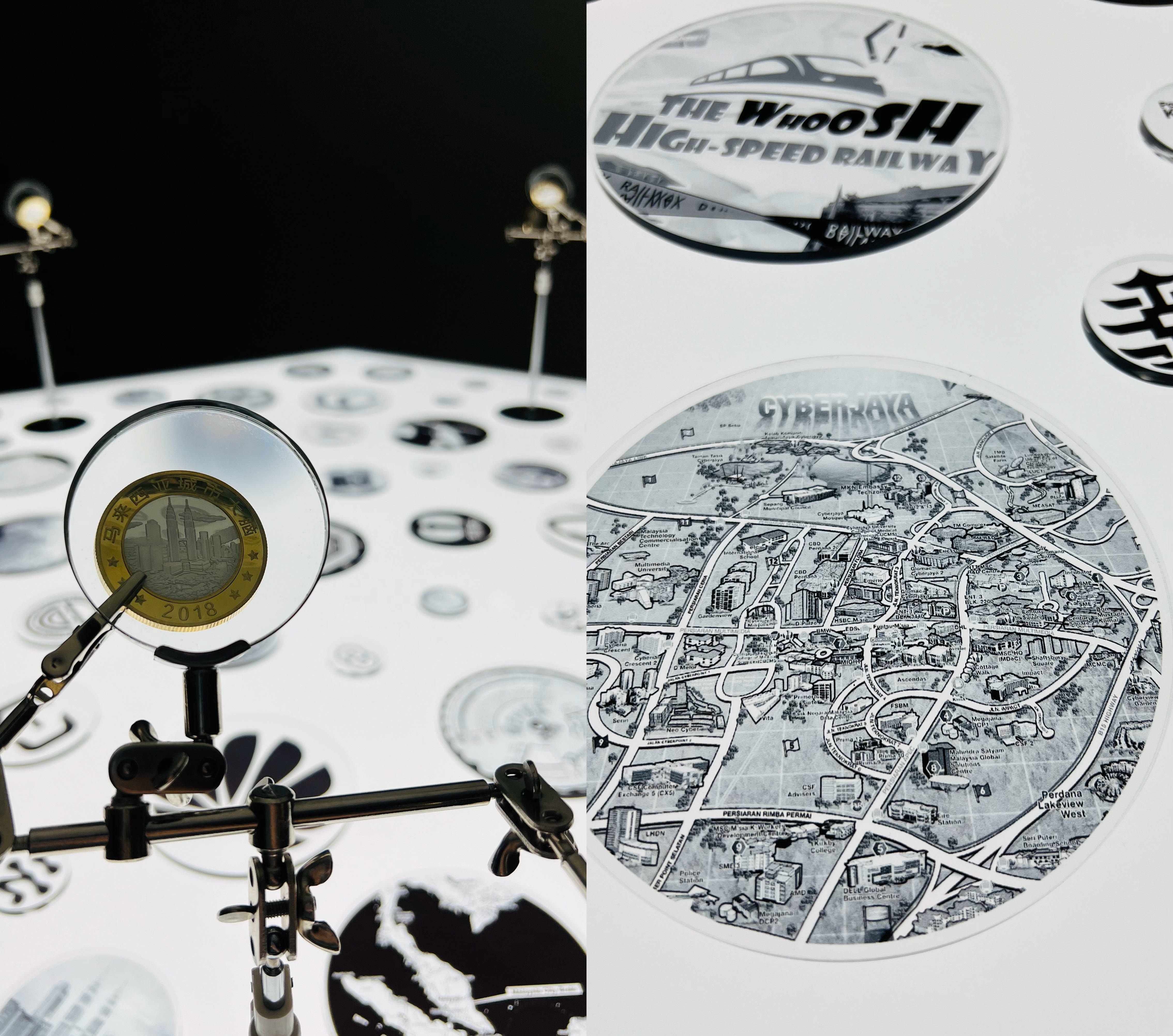
Beyond text and knowledge, the way that an artwork installed also shapes the audience’s way of thinking. ‘The Smart City’ displays various images related to the smart city project on a light box table, and five commemorative coins are placed on stands for the audience to examine them closely under a magnifying glass. The artist created these commemorative coins for each city in the Afrasian region that has joined the smart city project, including Mauritius. Commemorative coins are ‘deeply symbolic, and recalling China’s history of state-issued commemorative coins, they function as expressions of sovereignty that also construct an ideology’ (Wang, Ru-Xuan, 2024)3. Once again, this is a response to the reawakening ghost of the empire. ‘The Smart City,’ sets the images and coins in the way that the museum displays, suggesting the objectivity of the knowledge it presents. As Gillian Rose (2001) notes in the book, Visual Methodologies, a London street map dotting the areas where the poor population of East London lives ‘seemed to lay the East End bare to a scientific gaze that penetrated what others described as its darkest recesses.⁴’ By placing the images of the construction projects within petridish-like containers and on a light box used for observing biological specimens, ‘The Smart City’ suggests a scientific sampling of the real world. The act of sampling itself implies the existence of a ‘truth’ (the real world) from which samples are taken. The magnifying glass, acting as a symbol of the act of reviewing evidence, further emphasizes the credibility of the reality expressed in ‘The Smart City’ because objects or facts that withstand scrutiny can inspire confidence in their truthfulness. This, in turn, strengthens the sense of truth that the installation conveys to the audience.
In ‘Ghost in the Sea,’ Musquiqui Chihying weaves a narrative through video and installation, alluding to the ghostly remnants of an empire beneath the Afrasian Sea. The artist’s meticulous fieldwork provides a solid foundation for this exhibition, with each artwork intricately linked to the overarching theme. While the results of the fieldwork are undoubtedly significant, it is the artist’s compelling aesthetic expression that lends this exhibition a persuasive power. The exhibition sparked my curiosity, leading me to search for other related materials. These additional sources offered a narrative that differed from the exhibition’s perspective. While this new information doesn’t undermine the message of this exhibition about the ever-present nature of the imperial control, the alternative narrative, however, allows for the voices of those absent to be heard, potentially opening up another discussion.
The different actions taken by docile and active audiences in response to the discourses presented in exhibitions reflect what Gillian Rose has described that the credibility of the exhibition:
depends on the visitor’s prior faith in the accuracy of the anthropological knowledge used to make the display.4
I am not trying to question the credibility of this exhibition here, but rather to point out that it is more likely to form an effective knowledge development for the audience to actively engage in dialogue or even confrontation with the viewpoints proposed by an exhibition while accepting a set of arguments from the exhibition. Despite this, ‘Ghost in the Sea,’ still provides us with a meaningful exploration and fieldwork, revealing a narrative hidden beneath the sea.
-
https://au.int/en/treaties/african-union-convention-cyber-security-and-personal-data-protection ↩︎
-
https://www.heritage.org/index/pages/country-pages/mauritius ↩︎
-
王襦萱. Wang, Ru-Xuan. (2024, May 3). 全球視野下舉步維艱的鬼魂強權迫使移轉的生存技術:致穎個展「鬼魂與深藍海」. Struggling Spectres Under Global Gaze and Transferring Survival Techniques Forced by Power — Musquiqui Chihying’s Solo Exhibition ‘Ghost in the Sea.’ Art Emperor. https://artemperor.tw/focus/5985 ↩︎
-
Rose, G. (2001). Visual Methodologies: An Introduction to the Interpretation of Visual Materials. SAGE Publications. ↩︎