(This article was produced for the 2025 KCCA Art Writing Workshop and appeared in KCCA mag. No. 4 , pp. 22–29. )
On an early summer evening, the basement of the café felt a bit stuffy upon arrival. The two artists had already started the talk,
Hsiao: “At that time, I went to the Nanjing Space of King Car Cultural & Art Center (金車文藝中心臺北南京館) to see your solo exhibition. You used a lot of acrylic for the display. How did it help with the presentation of your work, or what was its role as an intermediary? I was a bit curious to see how others did it.
The exhibition Hsiao Yu-Chieh referred to was Fu Sheng-Ya’s solo exhibition, “The Temporality of Attachment (漬的時態)” in 2024, where she used transparent acrylic to support common household folded garbage bags, and often used acrylic sheets to suspend works on the wall or place them at a height, allowing viewers to directly observe various effects of paper.
Fu: “First, its transparency doesn’t steal the paper’s presence. Next, some works are color-separated and printed on different papers, but the colors are only visible when they are stacked together. Acrylic makes them fit more closely while still retaining the paper’s properties.”
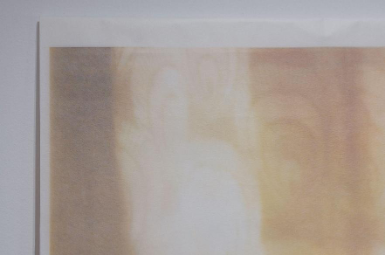
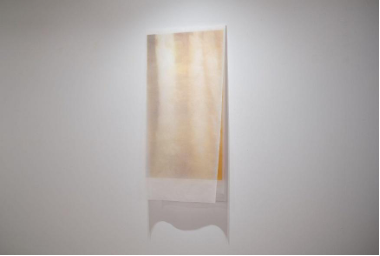
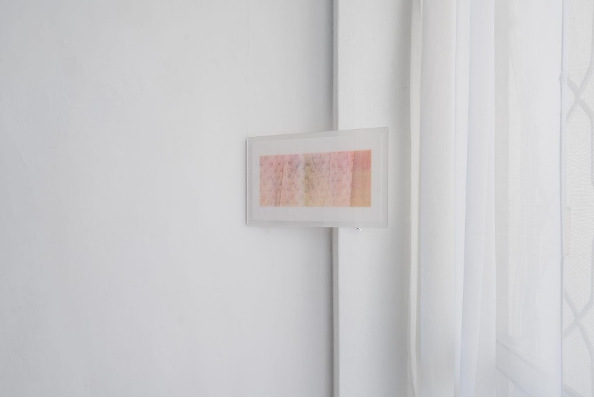
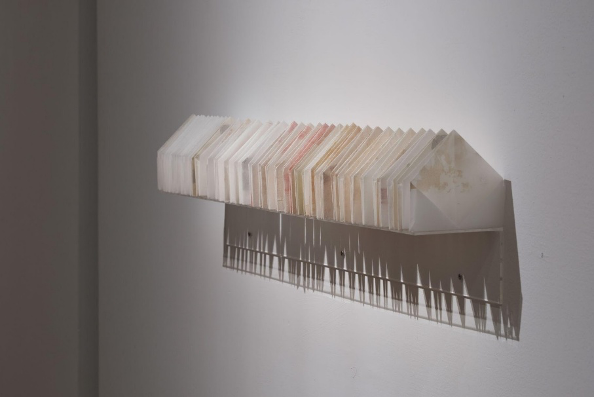
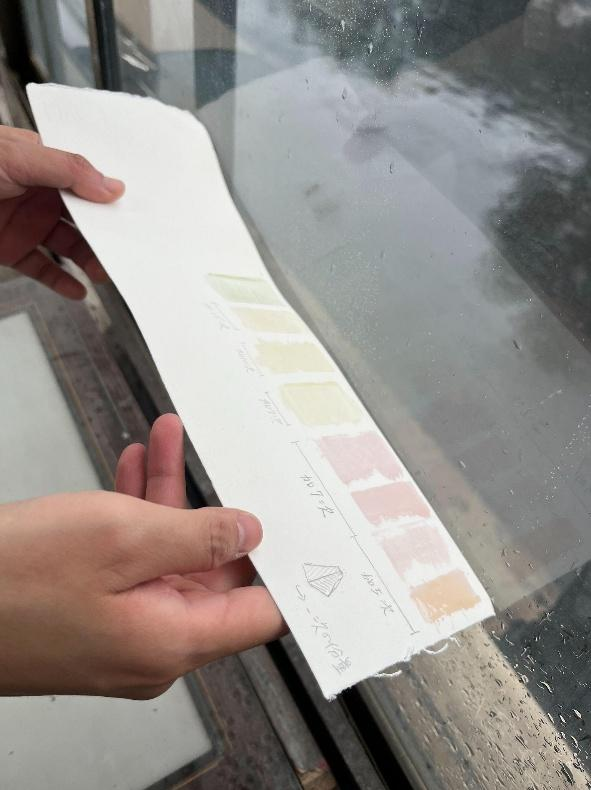
In the same year, Hsiao Yu-Chieh also exhibited her solo exhibition, “There’s Nothing Abstract About That (傾身觀看),” at Chengde Space of King Car Cultural & Art Center (金車文藝中心臺北承德館). In “Untitled (2024),” folded Xuan paper (宣紙) of varying thickness and width was stacked on a transparent acrylic sheet coated with pigment, creating an anger-sensitive halo effect due to the warm transparency of the Xuan paper.
Hsiao: “My idea of using acrylic is somewhat similar to yours; I also use transparent or translucent mediums to highlight certain characteristics. But for me, the interaction between acrylic and paper is different from yours. I care about how the characteristics of paper are emphasized, so acrylic in my work is more like an auxiliary to present different aspects of paper.”
Fu: “[Indeed,] Acrylic can maintain a certain lightness, or gently support something in suspension, which is why I use it a lot. But I actually still treat acrylic more as a way to highlight the paper material itself.”
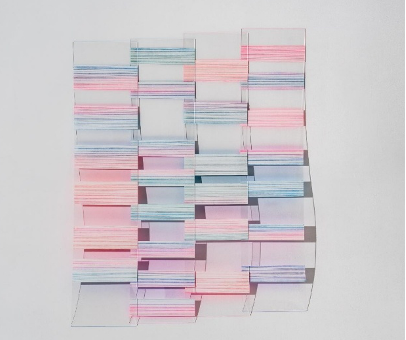
Now looking at both artists’ works again, I find that acrylic is visually almost non-existent, leaving only a certain “scent”. It actually still comes back to paper as a material, which was the reason for the two artists to be invited for this conversation. Fu Sheng-Ya does not reject so-called stains, or the marks left by human touch on paper, which signify relationships. On the other hand, for Hsiao Yu-Chieh, it’s more detached; she uses spray cans or other methods to reduce human brushstrokes.
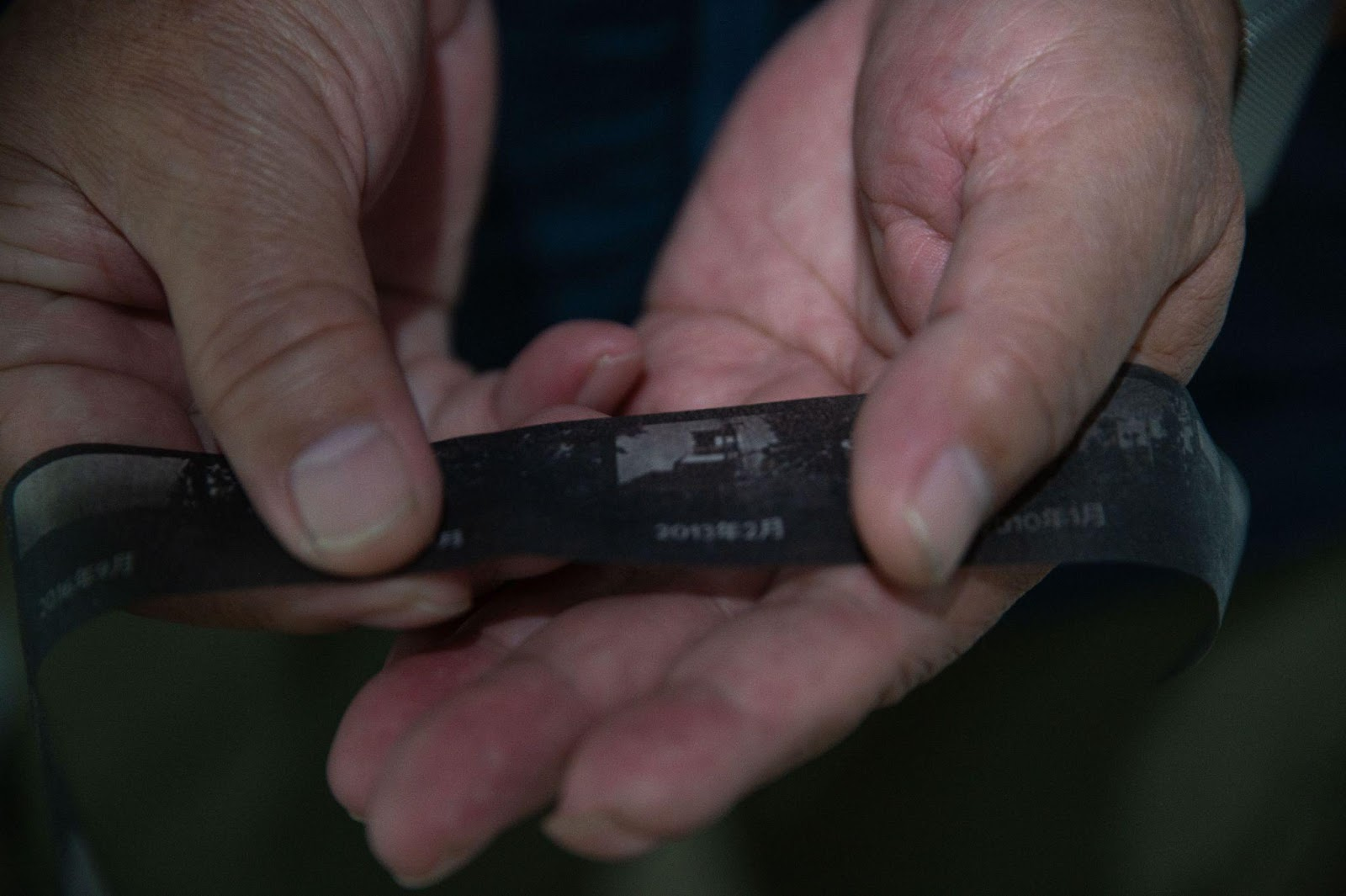
Fu: “Most of my works indeed contain a private story, or hide something. Like thermochromic ink, it takes a few seconds of touching for it to change color. The time delay from touch to viewing, I think, is also a very important process. As you touch it, you’ll feel that it seems to start with an event that an object generates warmth by you.”
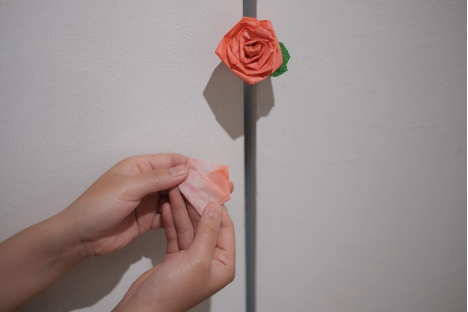
Hsiao: “Sheng-Ya’s works retain more traces of human events than mine; our creative concepts are fundamentally different.”
The ice in the coffee crackled due to the room temperature.
Hsiao: “I care about purely expressing the material, so I try to minimize human traces, which to me is simpler. I try to maintain a certain distance from my own work, to be able to evaluate and examine it in a relatively objective way.“
“Reducing human traces is largely because I want to keep it in a gray area. Some people say my work is Eastern because of the paper and ink, while others consider it Western due to its form. Walking the line between both genres, I hope to resists easy definition of my works; that state is what I find most comfortable.”
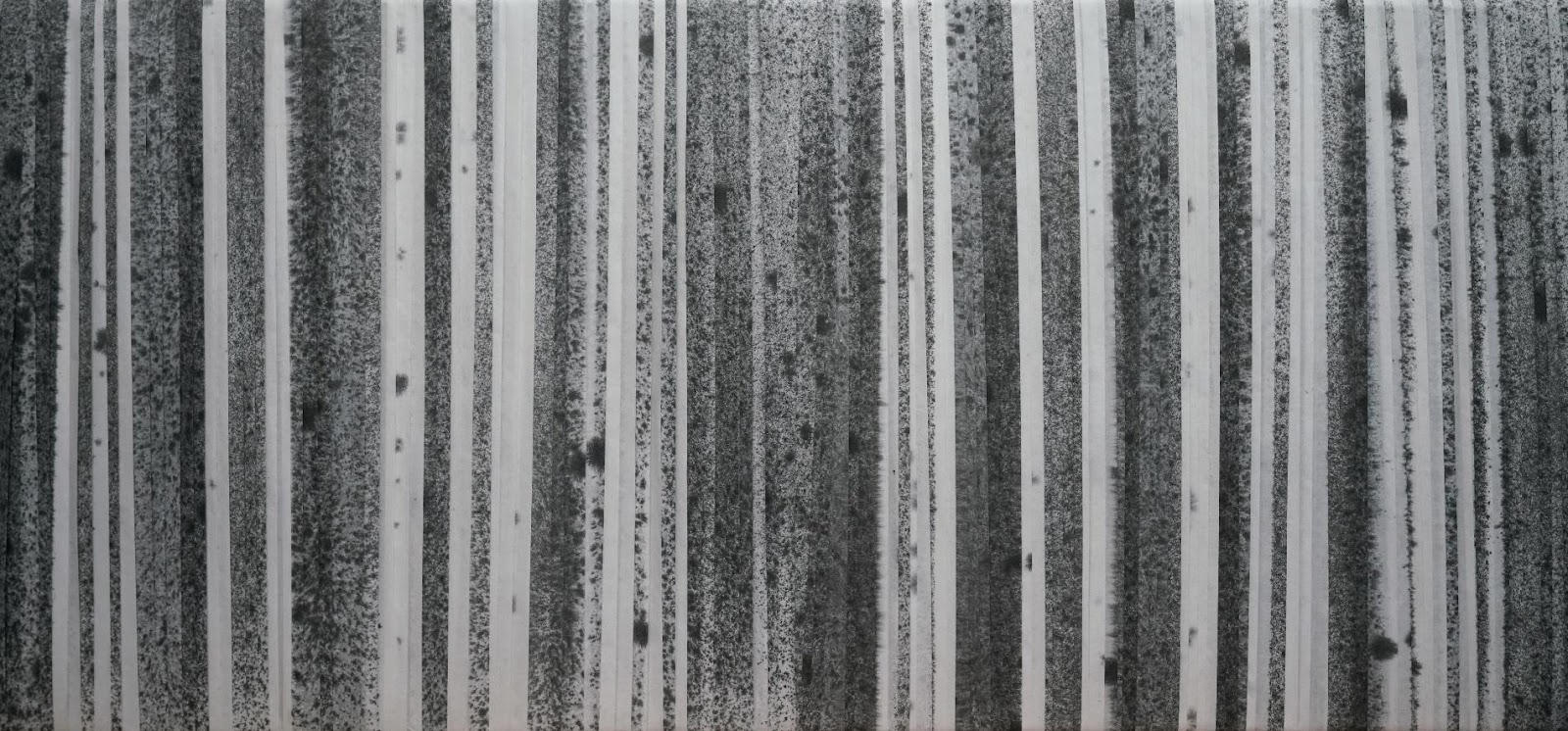
Fu: “I can imagine the feeling of Yu-Chieh’s using ink spray compared to drawing directly by hand. My works are more about a scene or an event, a photograph, then undergoing another layer of transformation.”
“Does it have anything to do with your printmaking experience?” I couldn’t help but interrupt and ask her. Fu Sheng-Ya is very willing to leave her own texture within the work.
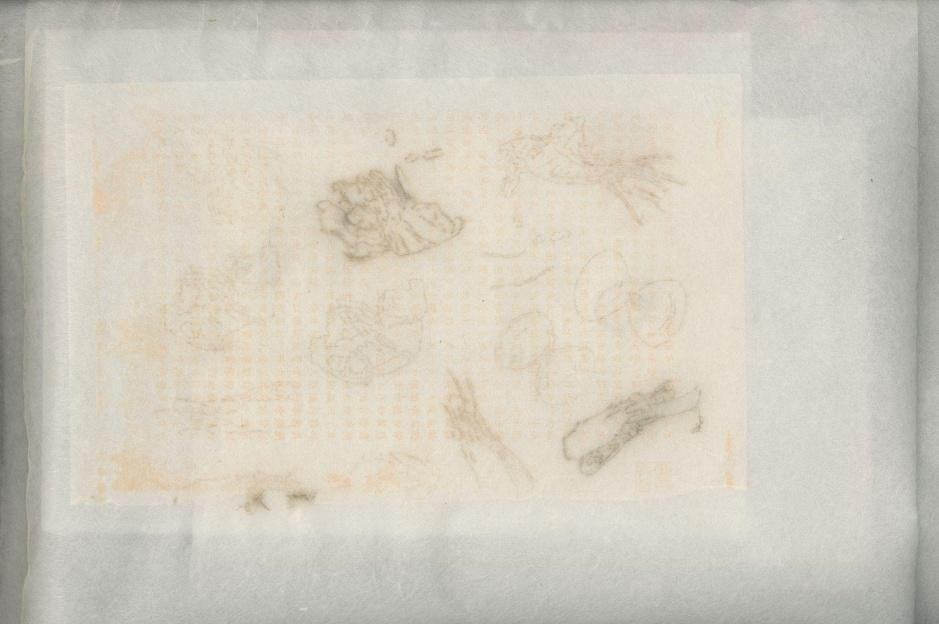
Fu: “Yes, for example, the text fragments on the paper in my work is actually legal documents from a family inheritance lawsuit. Breaking up the text and reforming it into the paper carries imagery or experience, like in handwriting or letters.”
“In ‘Paper Folding of Home,’ the laser-engraved shrimp shells patterns and garbage outlines, I actually use the image of leftover from family meals to discuss a certain sense of domesticity. It might look soft and cute at first glance, but the underlying meaning is certain fragmented experiences.”
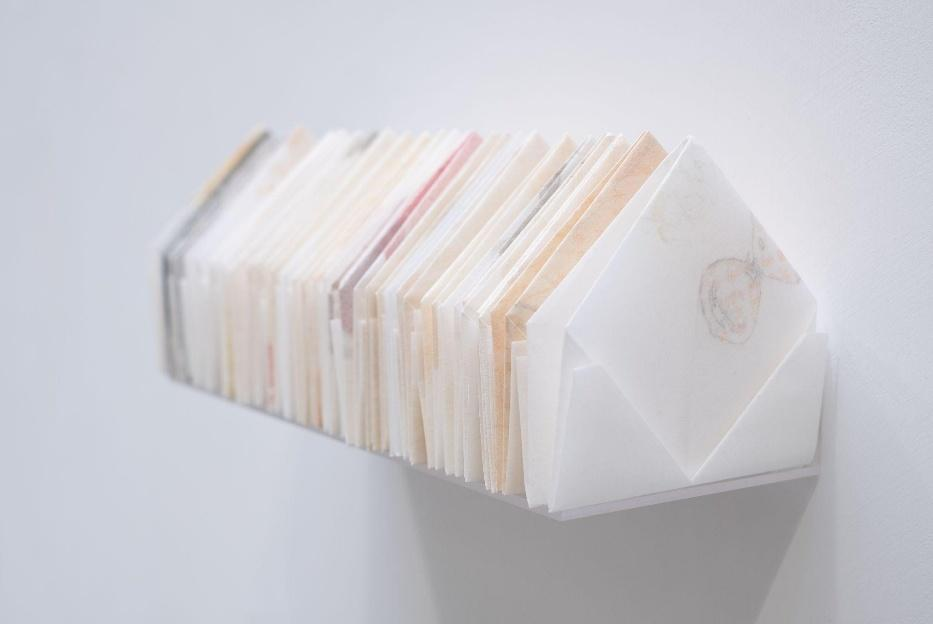
The café owner came downstairs for a quick check and then went back up. The air conditioning had made the room much cooler, but the conversation became more lively. I was curious about Fu Sheng-Ya’s mention of transforming life experiences, because in her artworks, there is no direct correspondence between life experiences and materials. For example, with the family folded garbage bags, one would instinctively associate them with calendar paper, advertising paper, or newspapers commonly used by Taiwanese in households, but the paper chosen by Fu Sheng-Ya does not deliberately link to that scene.
Fu: “I usually buy paper at a paper-making studio on Songjiang Road.”
Speaking of the purchase of materials and the characteristics of various paper products from different manufactors, the two artists launched into an enthusiastic sharing of experiences. After a while, Fu Sheng-Ya continued,
Fu: “One of their papers incorporates a slight amount of plastic, making its texture slightly tougher. Some of my spatial installations use this paper, so they are not affected by weather changes and environmental factors.”
“Or the ink I print needs light to develop color. When printed on very thin paper and stacked together, when exposed to light, you’ll see a slightly gray shape inside, carrying the implication of impending damage, or only visible at specific angles. This is a manipulation I like to play within my work.”
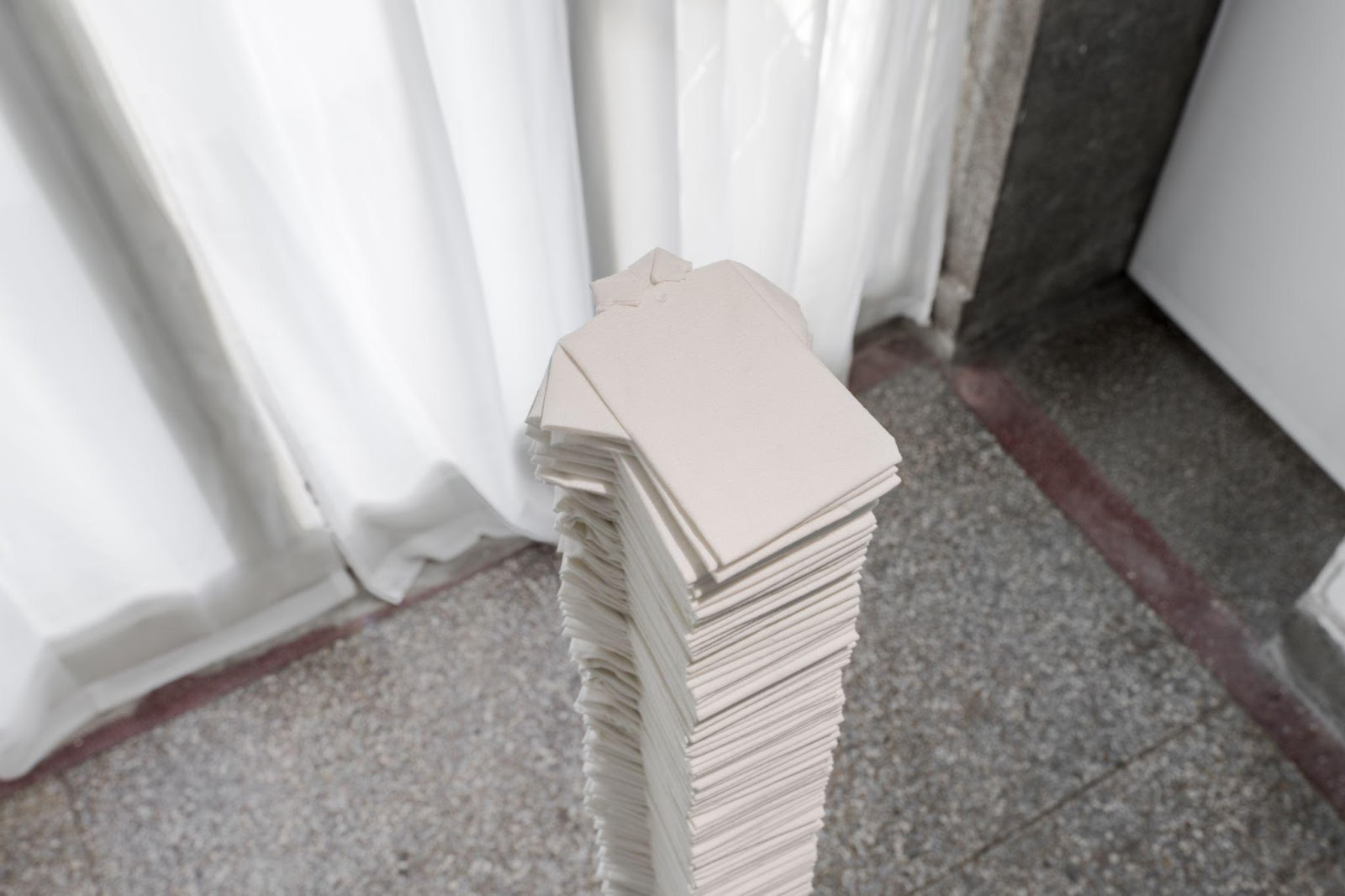
“I hope the material is not easily directly identifiable. For example, in ‘Folded_Storage,’ toilet paper is folded and stacked into a column. The audience won’t identify it as toilet paper at first glance, but through the edges of the material during viewing, they will realize what it is, and then approach that familiar life experience, form, and its era.”
Hsiao: “I think visual artists share this characteristic: they don’t want their ideas and expressions to be seen too directly. For me, if I want to purely understand the material, maximization of the artist’s detachment is relatively effective, otherwise it will affect the view.”
“Sheng-Ya deals with many experiences originating from life, but I don’t want my own life story to be overly prominent in the visual presentation of my work. Generally, the story in my work is not easy to be discovered, but many people still want to ask, to understanding my works through stories.”
At this point in the interview, I gradually discovered that even though the two artists’ approaches to paper were different, their attitudes were remarkably similar. Fu Sheng-Ya and Hsiao Yu-Chieh both hope that the audience will generate feelings when facing the paper first, and then proceed to understand their work. Paper is always the foremost element.
Fu Sheng-Ya mentioned that although there are events in her works, they are always suppressed to be extremely faint during presentation, becoming some indiscernible traces within. During our conversation, she shared many choices regarding materials and techniques, but I recalled her exhibition statement, which heavily described the sub-theme of life experiences. “After the audience reading it, it was like, ‘Oh, so this exhibition is discussing these stories,’ and then all your craftsmanship and material concerns disappeared,” I raised this question.
Fu: “I might prefer to discuss material, or wait for audiences to respond my artwork, the details of techniques, and why these approaches occur.”
“[for example] Special inks like thermochromic and photosensitive inks can only be seen at specific distances, light, and temperatures, and there will be differences when installed indoors or outdoors. My recent works all start from material characteristics, thinking about how to create specific viewings. I think this is my trajectory this year. Others usually talk less about this material part when viewing my works.”
Bystanders in the coffee shop looked at us with curious eyes. At that time, we were discussing how audiences tend to view Hsiao Yu-Chieh’s works from the perspective of formal aesthetics and spirituality.
Hsiao: “Everyone talks about spirituality, but how to express it, or where does spirituality come from? For me, perhaps it still needs to rely on actual behavior and direct touch through physical objects to feel. Especially touch, if you don’t touch it, it’s relatively difficult to feel what’s happening around you.”
In fact, many interactions between paper and ink occur during Hsiao Yu-Chieh’s creative process. For example, Xuan paper is used as the base, covered with another sheet of paper, and after ink spraying, the top paper is removed, leaving straight edges on the Xuan paper.
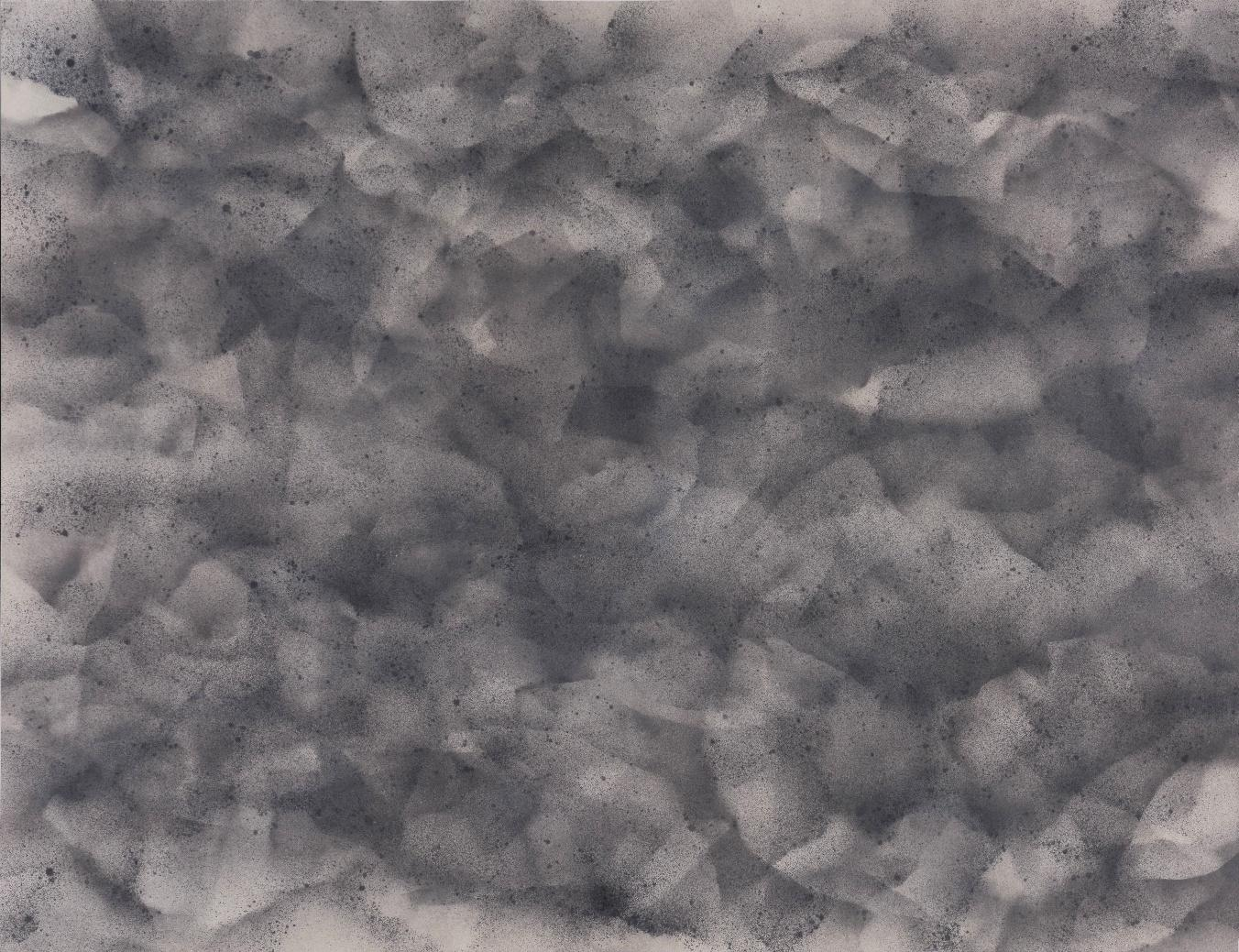
She will carefully keep those removed, ink-stained waste papers that do not belong to the current work, but will become materials again in the future.
Hsiao: “I focus on material expression. Although these waste papers initially serve as auxiliary roles, their essence is still Xuan paper after being used, so I keep them. Or, if paper fibers got wet, they cannot be folded flat and will have a curved thickness. People might consider this a defect, not stable enough, but for me, how to use this characteristic is a very important thing.”
“I feel that papers in my hands create with me, and what happens in between, let’s call them side quests, actually develops into their future appearance.”
(All images in this article are provided by the artists.)